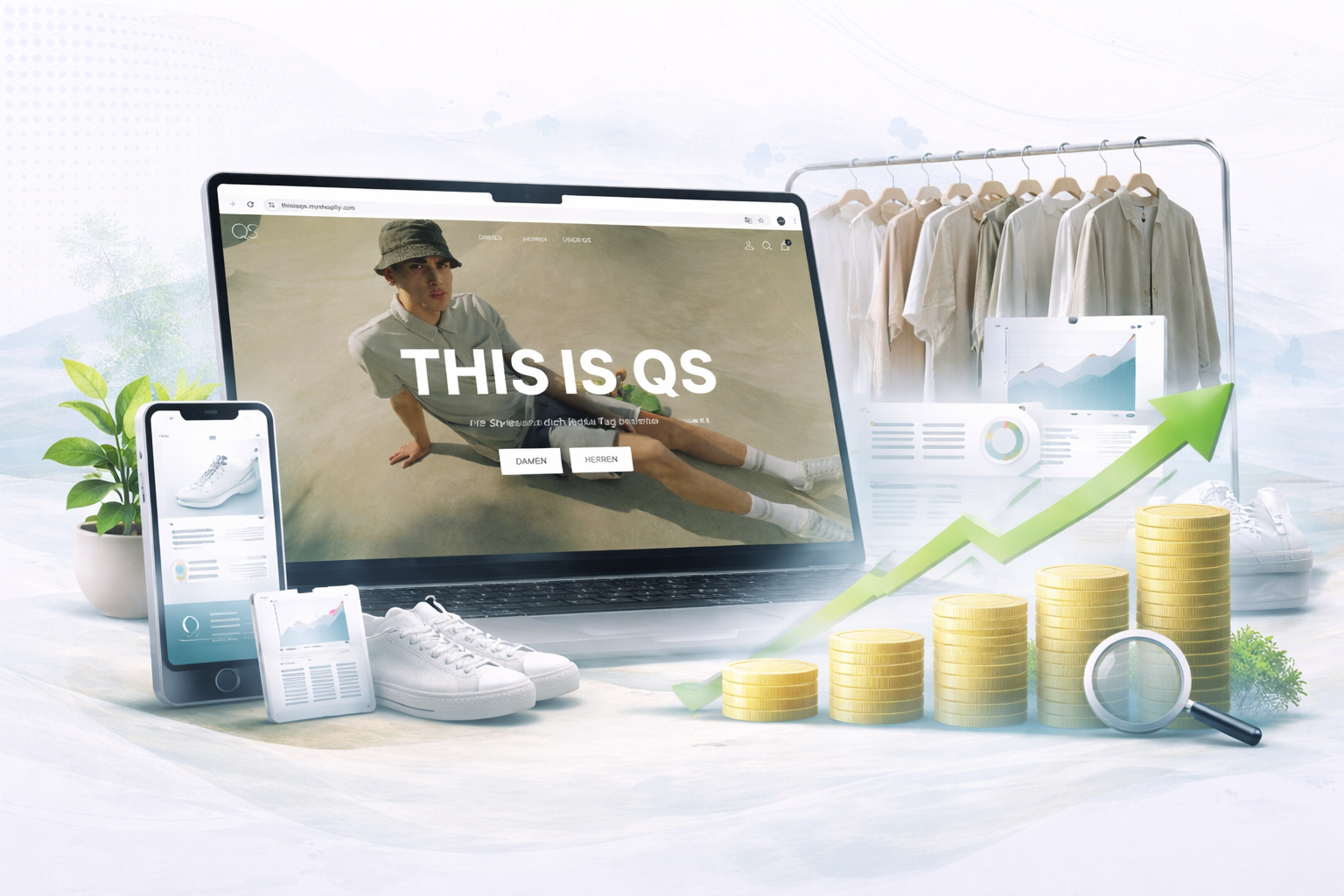
This case study shows how within the S. Oliver Group An independent D2C brand was successfully launched — despite group structures, bureaucracy and technical hurdles.
In focus: Radical Solution Orientation, UX Design and Intelligent Integration of Existing Systems.
The case is aimed at Investors, Partners, and Shopify CustomersWhich face similar challenges — and shows how scalable D2C brands can also be in a corporate environment.
QS Was long as a sub-label in the main shop of s.Oliver Integrated and had neither its own online presence nor a digital brand identity.
In spring 2025, the strategic decision was made to use QS as independent lifestyle brand To reposition and to sell directly to end customers.
Within a few weeks, several initiatives were launched in parallel:
Am May 3, 2025 QS opened its first flagship store in Würzburg and opened at the same time with a new Shopify online store Live — accompanied by a Exclusive capsule collection With Brand Ambassador Vanessa Mai.
The whole thing marked the official start of the new, independent brand identity.
A central element: Community building.
Customers can upload their own styles, share looks and inspire each other on the new platform — the online shop is Not just a sales channel, but an interactive community platform.
“QS is more than just a fashion brand — we see ourselves as a platform for people who want to show off their style and attitude. The new store, the online shop and our community activations create places where exactly that is visible — online and offline.”
— Benjamin Isenheim, Brand Director QA
This repositioning made QS a full-fledged direct-to-consumer brand within the S. Oliver Group.
For the online rollout, this meant: An independent shop with a clear brand experience, in sync with the retail launch — without destabilizing the parent company's existing structures.
1. Bureaucracy & slow decision-making processes:
As part of a multi-brand group, all decisions had to go through numerous approvals. From branding to IT security, sign-offs dragged on — compliance requirements made rapid iterations difficult.
2. Unclear distribution of roles:
There was friction between the QA brand team (autonomous, fast) and corporate IT/e-commerce (process-driven).
Responsibility for the new D2C shop was initially not clearly defined — this led to delays.
3. High coordination costs:
Marketing, IT, logistics, legal, sales — all stakeholders had to be involved. Meetings, Presentations, and Feedback Loops jeopardized the tight schedule.
4. Technical starting point:
QS had No own e-commerce know-how, and Existing Enterprise Systems (especially the Central ERP) were Not for rapid D2C implementations laid out.
Missing interfaces (e.g. inventory reconciliation, order transfer) would have led to manual processes.
The project was developed by the Shopify agency led by Benedikt Böhnke (project management) and Benedikt Mühlberger (Technical Lead) Supervised — with a clear goal: Solutions instead of Blockages.
A small core team was empowered to make decisions independently.
In this way, many details could be resolved without going through the entire group hierarchy.
Not all “nice-to-haves” had to be ready for launch.
A working Shopify store in six weeks Was the goal — everything else came in Stage 2.
Based on a proven Shopify theme In record time, a Visually strong, urban brand world implemented.
Colors, Typography and Imagery Consistently followed the brand DNA — the result: a Premium look despite short time-to-market.
The project team worked in Daily Sprints, shared Shop Previews and Prototypes Continuously with QA and Group Decision Makers.
This allowed feedback and approvals parallel Successes — Trust and speed increased equally.
Since that SAP ERP Could not be fully integrated in the short term, were Pragmatic interim solutions created:
So there was No technical showstopper — Timing was a priority.
Parallel to backend integration, the focus was on User Experience.
Since the target group is mobile-first, the shop was optimized for smartphones.
Features such as “Shop the Look” or Social content integration (#funiswhereyouare) Strengthened the community feeling.
Kleine User testing Ensured a smooth checkout and clear navigation.
“Despite corporate structures, we managed to bring QS live in record time — because we worked in a focused and streamlined manner.”
— Benedikt Böhnke, Project Lead QA Launch
That Symmetry theme by Clean Canvas formed the basis for the front end.
Its modular architecture allowed a Quick adaptation to the QA brand world.
The system was supplemented by targeted technical solutions:
In the future, they will PDPs Headless with Coveo Operated — for dynamic product listings, intelligent search and personalized recommendations.
Despite all obstacles, QS went on Live on time on May 3, 2025 — parallel to the store opening in Würzburg:
👉 www.thisisqs.com
The launch was perfectly tailored to marketing measures — Vanessa Mai, social buzz, and community engagement resulted in strong traffic and sales.
QS quickly established itself as Independent digital brand with a clear identity — independent of the s.Oliver system.
Thanks Shopify Plus Can that Marketing team independently display content, products and campaigns, without major IT dependency.
The system remains stable, performant and scalable, even during traffic peaks.
At the same time, QA became internal to Blueprint Project for D2C within the S. Oliver Group — one Proof that agility and modern platforms They also work in a corporate environment.
Die QA Case Study Proves that Scalable D2C models in a corporate context Have it implemented successfully.
With Shopify Plus And a clear focus on Customer Experience In record time, a New Sales Channel built — without lengthy IT projects.
The result:
For the S. Oliver Group Does success mean: Investments in flexible technologies and agile teams are paying off.
QA is a Best practice example of digital brand development Within the Group.

Get in touch
contact now