


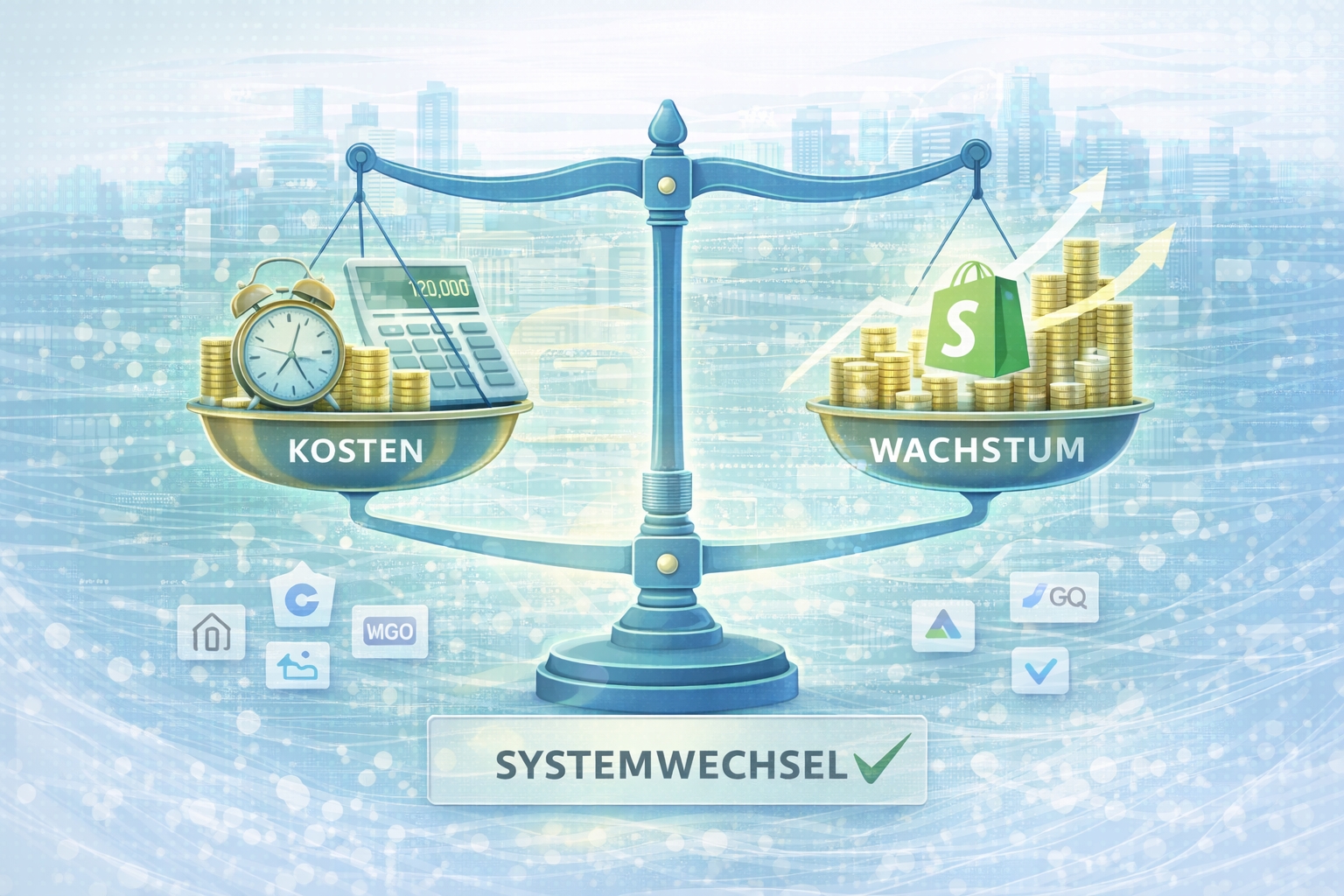
Changing a shop system is not a cosmetic project.
It is a strategic capital allocation.
But the real question is:
Does a system change pay off economically — or is it just a technical upgrade?
Replatforming must pay off.
Replatforming is the structured switch from a shop system (e.g. Magento, Shopware, WooCommerce or a custom solution) to Shopify or Shopify Plus.
It comprises:
It's no small project.
And that is why the ROI question must be answered clearly.
The most common triggers include:
Increasing maintenance costs.
Complex hosting structures.
Technical debt.
Slow development cycles.
High developer dependency.
Difficult internationalization.
performance issues.
But not all pain justifies a system change.
The decisive factor is whether the existing system structurally prevents growth.
Replatforming pays for itself through concrete, measurable factors.
.png)
Many enterprise systems cause:
Shopify drastically reduces this complexity.
Less infrastructure means lower fixed costs.
If every feature change takes weeks, the company loses agility.
become.
Speed is an economic factor.
Legacy technical issues have a direct impact on conversion.
Faster load times, better UX structures and more modern checkout processes measurably increase conversion.
Even a conversion increase of 0.3—0.5% can generate significant additional income with larger sales.
Many systems function up to a certain turnover level — and then structurally collapse.
Shopify Plus is designed to process high transaction volumes stably.
Scaling without frictional losses saves migration costs in the long term.
An underestimated factor:
Internal teams spend less time on system issues—and more time on marketing, product, and expansion.
This fundamentally changes the focus of a company.
A system change does not pay off if:
Replatforming reinforces existing strengths — or weaknesses.
A reputable ROI case takes into account:
Exemplary:
If a company generates €3 million in turnover and achieves 0.4% more through better performance + conversion, this can already generate six-digit additional sales.
If infrastructure costs fall at the same time, there is a double ROI effect.
Replatforming amortisiert sich häufig in 12–24 Monaten – wenn strategisch geplant.
Viele Unternehmen migrieren aus Frust – nicht aus Strategie.
Es ist ein Management-Projekt – kein reines IT-Projekt.
Richtig umgesetzt kann ein Systemwechsel:
Falsch umgesetzt kann er Kapital binden und Ressourcen blockieren.
Die Entscheidung sollte niemals aus Trendgründen getroffen werden.
Du willst wissen, ob ein Systemwechsel wirtschaftlich sinnvoll ist?
Wir analysieren deine bestehende Systemlandschaft, Kostenstruktur und Wachstumsziele – und berechnen realistisch, ob und wann sich ein Replatforming amortisiert.
👉 Jetzt Migrations-Analyse anfragen.
👉 Unsere Shopify Services entdecken

Get in touch
contact now
