As soon as a Shopify store reaches a certain size, a fundamental strategic question almost necessarily arises:
Are we building up internal know-how — or are we bringing external specialists on board?
At first glance, having your own team seems cheaper and more controllable in the long term. But when you look closely, it's not just about costs. It's about Speed, specialization, scalability, and risk.
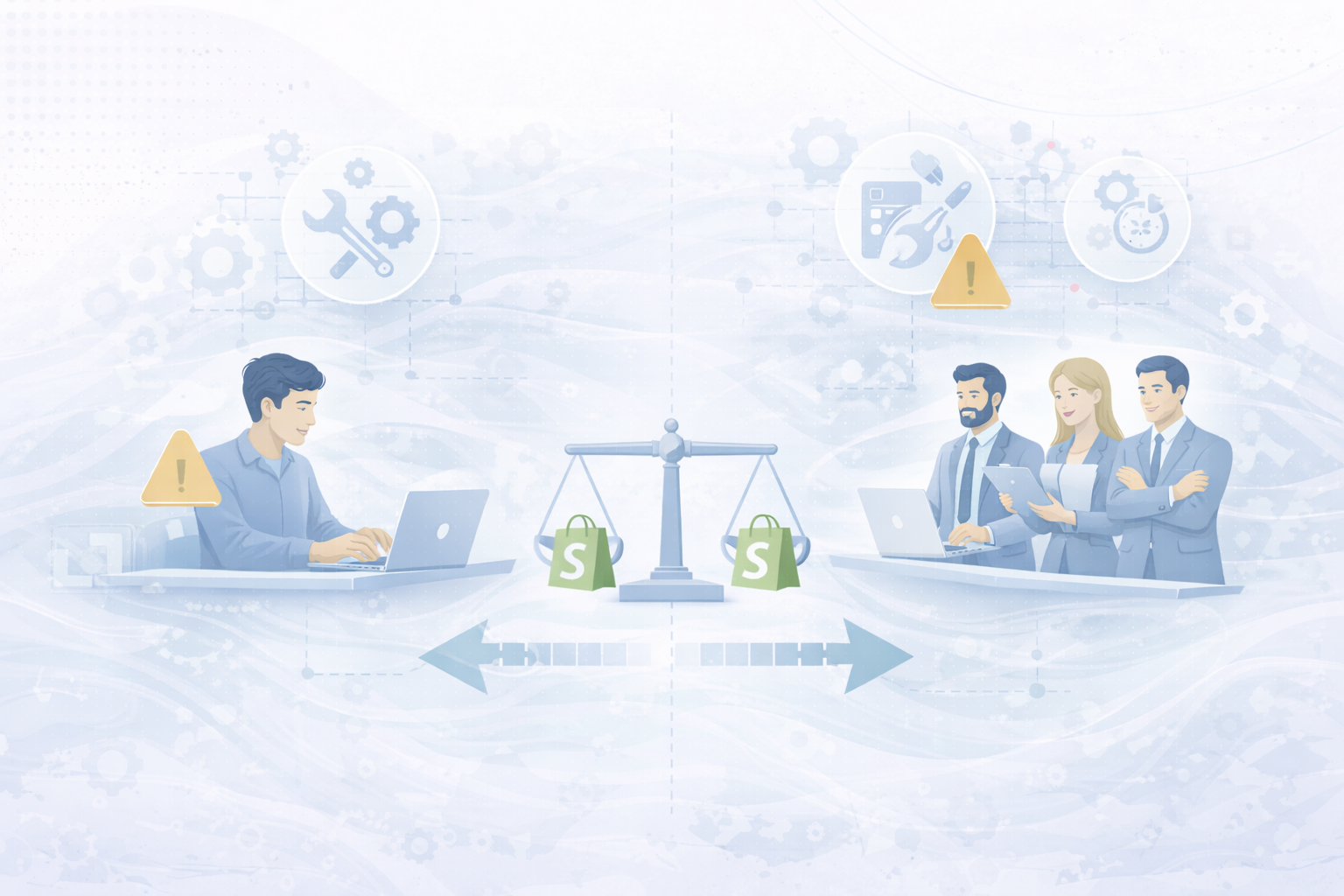
The decision between in-house team and Shopify agency is not an operational decision, but a structural growth decision.
Building an internal team sounds attractive: full control, direct communication, long-term knowledge development within the company.
But the reality is more complex.
A powerful Shopify store doesn't just need a developer. Modern e-commerce architecture includes:
An individual employee cannot cover these disciplines to the same extent as a specialized team.
If you calculate realistically, a well-established in-house team will quickly incur total annual costs in the range of 200,000€ to 350,000€, including additional costs, recruiting, tools and management expenses.
In addition, there is an often underestimated factor:
Dependence on individuals.
If a central developer leaves the company, there is not only a personnel gap — but often also a loss of knowledge.
An experienced Shopify agency bundles expertise from numerous projects. This results in pattern recognition, process clarity and speed.
Agencies see:
This experience can only be built up internally over years.
The biggest advantage of a specialized agency therefore lies not only in implementation — but also in strategic error prevention.
.png)
In e-commerce, time-to-market determines competitive advantages.
An internal team naturally works more intensively in coordination processes, prioritization cycles and internal resource conflicts.
An external Shopify agency, on the other hand, is project-focused. The goal is clearly defined, resources are bundled, roadmaps are structured.
This speed can be decisive, especially when it comes to relaunches, migrations or performance projects.
Slow iterations cost market share.
An internal team knows the company deeply.
An agency brings distance.
This distance is often more valuable than you think.
Many e-commerce projects fail not because of technology, but because of operational blindness.
UX errors are not detected. Conversion weaknesses are normalized. Complex structures are accepted “developed over time.”
An external perspective questions assumptions — and that is often the biggest lever.
In practice, a hybrid approach is increasingly emerging as the most efficient solution.
A small internal team manages brand, content and operational issues.
External Shopify experts take on:
This model combines internal control with external specialization.
It reduces fixed costs, increases flexibility and allows scaling as needed.
The key question is not: “Which is cheaper? ”
But: Which structure maximizes growth with calculable risk?
If large volumes of development are available on a continuous basis, an internal team can be useful.
However, when project peaks, strategic changes, or technological transitions are pending, a specialized Shopify agency is often more efficient.
The decisive factor is whether your company:
The right decision depends on the company phase, growth goals and complexity.
For many growth-oriented brands, a specialized Shopify agency isn't a cost factor — it's an accelerator.
Structure beats gut feeling.
Whether it's an in-house team, an external Shopify agency or a hybrid model — we analyze your current situation and show you transparently which setup makes economic and strategic sense.

Get in touch
contact now