Many online shops invest in keywords, backlinks and technical optimization — and yet wonder why they don't rank sustainably.
The reason is often deeper.
Google no longer only rates websites based on keywords.
With the E-E-A-T principles, the focus has shifted: away from pure optimization — towards Trust, experience and quality of content.
This is particularly important in e-commerce and especially in Shopify shops.
In this article, you'll learn how Shopify SEO works according to E-E-A-T and how to build stable rankings over the long term. 🚀
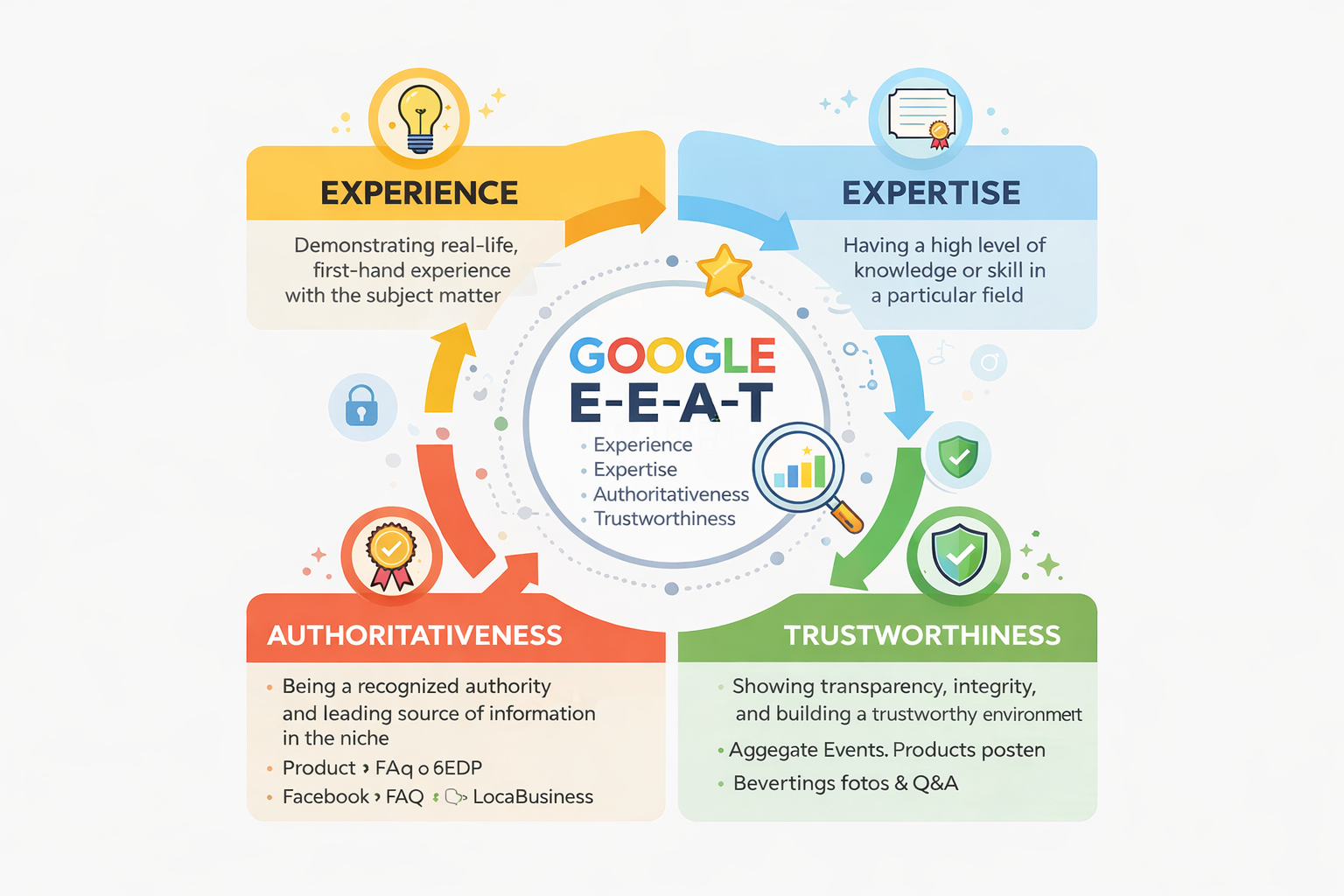
E-E-A-T stands for:
Google uses these principles to evaluate whether content is trustworthy and of high quality — particularly for transactional and purchase-related search queries.
For Shopify, that means:
SEO isn't just technology.
SEO is brand management.
A Shopify store is transactional by definition.
As soon as money flows, Google's demand for trust signals increases.
The following are particularly affected:
If you want your shop to rank in highly competitive areas, “optimized content” is no longer enough.
You need:
Google wants to see content come from real experience — not from generic text.
For Shopify SEO, this specifically means:
Product descriptions should not only list features, but describe real application scenarios.
Instead of:
“High-quality sneakers with rubber soles. ”
Better:
“These sneakers are particularly suitable for long city walks, as the flexible sole reduces pressure points. ”
Experience is shown by:
Longtail keyword example:
“Optimize Shopify Product Description SEO”
Expertise is not created by many keywords — but by substantive content.
A Shopify blog that only publishes superficial 800-word articles won't build up much authority in the long term.
Instead:
For example, if you're writing about “Optimizing Shopify SEO,” the article should also cover topics like:
The more comprehensively a topic is covered, the more strongly it signals expertise.
Authority is created by:
A Shopify store can build authority by:
If your shop is perceived as a source of information, rankings rise stably over the long term — not just temporarily.
Longtail keyword potential:
Trust is crucial in e-commerce.
Google rates, among other things:
UX also plays a role:
An uneasy, unsafe shop not only loses conversion — but also long-term ranking stability.
Technology alone does not fulfill E-E-A-T — but it supports it.
Key technical aspects:
Shopify in particular offers good basics here — when themes are cleanly developed.
E-E-A-T is not a quick fix.
It is a long-term development process:
This makes SEO more sustainable — and less dependent on short-term ranking fluctuations.
Many shops make these mistakes:
#
E-E-A-T helps to solve precisely these weaknesses structurally.
If you want to rank on Google in the long term with Shopify today, you need more than keywords.
He needs:
experience.
expertise.
authority.
trust.
E-E-A-T is not an additional ranking factor.
It is the basis of modern search engine optimization.
SEO isn't a plugin — it's a build of trust.
If you want to know how strong your Shopify store is really positioned in terms of E-E-A-T and where structural SEO potential lies, we will analyze your setup holistically — technically, in terms of content, and strategically.

Get in touch
contact now