Almost every company website has a clear goal:
Generate inquiries, establish contacts, start conversations.
And yet, time and again, we see websites that:
... but no or hardly any inquiries produce.
This is rarely due to individual details.
It is usually a fundamental problem of structure and thought.
.png)
Many websites are treated as an image brochure:
The problem:
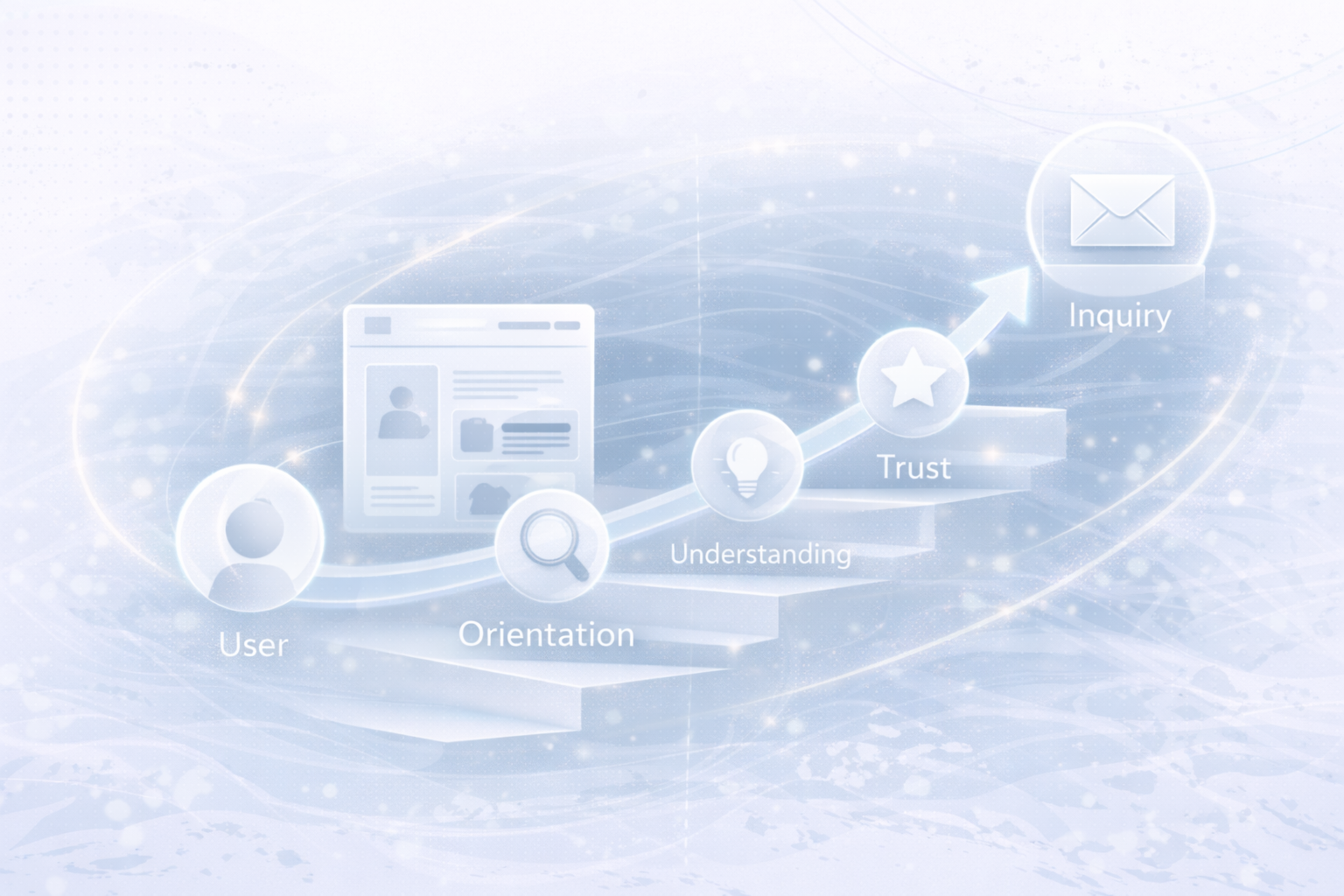
Users don't come to a website to get to know a company —
They come to to solve their own problem.
If a website does not adopt this perspective, there is no relevance — and therefore no request.
A typical pattern:
It often remains unclear for users:
If this clarity is missing, the website is abandoned — often without a conscious decision.
Corporate websites are often cluttered:
This does not lead to more understanding, but to cognitive overload.
Prioritize good websites:
By creating orientation, you lower the mental hurdle to making contact.
Many websites try to create trust by saying so:
Such statements are interchangeable — and are barely noticed by users.
Trust is created by:
The less someone “needs to be convinced,” the more likely they are to have an inquiry.
The home page is important — but it's rarely the only entry point.
Many visitors are coming:
If only the start page is convincing, but other pages are disoriented, the contact process is aborted.
Each relevant page should:
Requests rarely come from a click — but from a sequence of good impressions.
A common reflex:
“We need better CTAs. ”
However, buttons such as “Inquire now” or “Get in touch” only work if clarity has been established beforehand.
Without:
A CTA feels like a leap into the unknown.
Good websites introduce users to a request step by step — instead of forcing them to do so.
In practice, we see that high-query websites usually have the following in common:
It's not about impressing visitors —
but to them to make a decision easier.
When a corporate website doesn't generate inquiries, it's rarely due to design or technology.
Mostly missing:
Websites that generate queries are not trying to convince.
They help users to see for themselves.
Websites that look great are easy to build.
Websites that generate inquiries need structure.
We design and develop corporate websites that provide users with orientation, build trust and lead to clear decisions.
👉 About UNHYDE's website expertise

Get in touch
contact now