“Which shop system is the best? ”
We hear this question a lot — and it almost always leads in the wrong direction.
Because Shopify, WooCommerce and Shopware are not simply technical tools that you can objectively “let you win against each other.” They are strategic platforms, who make very different assumptions about how e-commerce works, how teams work and what growth should look like.
The right question is therefore not:
Which system is better?
But: Which system is right for my business, my team and my goals?
Shopify is a SaaS system, which is designed to make e-commerce as stable, high-performance and low-maintenance as possible. The biggest advantage lies not in individual features, but in the Overall consistency of the system.
This approach is particularly crucial for brands that want to grow — nationally or internationally. Shopify forces companies to focus less on technology and more on Product, marketing, and user experience to employ.
The price is clear:
Shopify provides less profound customization options as open source systems. In return, you get stability, speed and a checkout that converts measurably well.
WooCommerce is not an independent shop system, but a plugin for WordPress. This is precisely where both its strength and its greatest weakness lie.
The big advantage of WooCommerce is flexibility. Almost anything can be adapted, extended or changed — provided you have the technical know-how or a strong development team. WooCommerce can therefore be attractive for content-driven websites or very individual requirements.
In practice, however, there is often another side:
Performance, security, stability, and scalability depend heavily on hosting, plugin quality, and maintenance. The bigger a shop gets, the more complex the system becomes — and the higher the maintenance costs.
However, for fast-growing shops, WooCommerce is fast technically and organizationally demanding.
Shopware is a widely used shop system in Germany, which is used primarily in Mittelstand and with B2B-related business models is used. It offers a high level of flexibility, modern architecture and many options for customization.
This means that Shopware develops its strength especially when companies are ready Time, budget, and internal resources to invest in design, development and maintenance
However, for smaller teams or rapid scaling, this complexity can be a disadvantage.
Many comparisons depend on features:
Payment methods, plugins, templates, modules.
Here, the fundamental differences between Shopify, WooCommerce and Shopware are very clear.
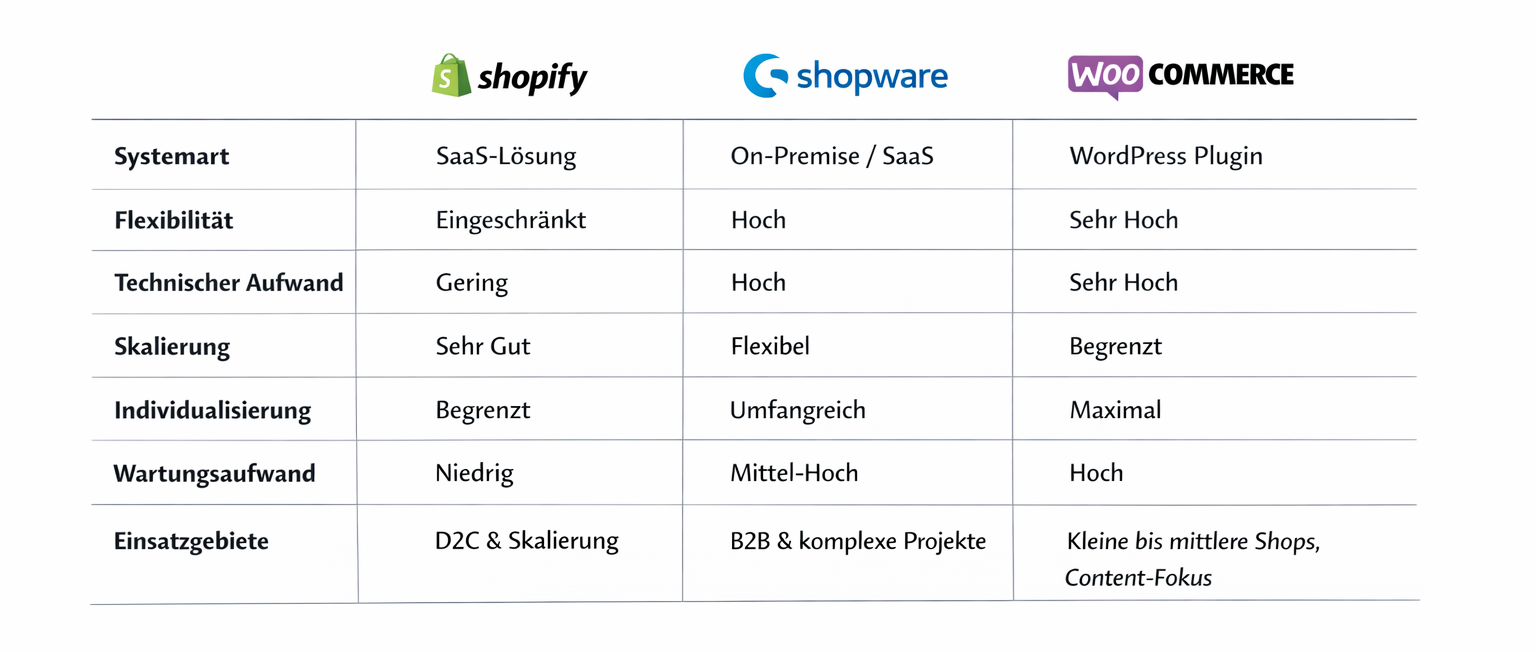
When you put all factors together, the picture is clear:
Shopify is ideal for businesses that Want to growwithout losing yourself in technical complexity.
WooCommerce fits projects where Content and individuality are more important than scaling.
Shopware is suitable for companies with complex requirements and the willingness to invest in structure and technology.
Shopify, WooCommerce, and Shopware aren't opponents — they're answers to different needs.
Whoever chooses the wrong system pays — not immediately, but permanently.
Shopify isn't the right choice for every business —
But for many, it's the most strategically sensible.
If you want to check whether Shopify is for your Business model fits and what a setup should look like that scales and converts cleanly in the long term.
👉 Discover UNHYDE Shopify services

Get in touch
contact now