Why international SEO is more than just translation

Many companies believe that internationalization means:

  • Translate shop
  • Activate new currency
  • Place ads abroad

But SEO works internationally according to different rules.

Google rated:

  • Domain structure
  • voice signals
  • Geo-signals
  • Hreflang implementation
  • Content quality
  • Market relevance

An incorrect structure can slow down rankings for years.

International SEO is an architectural decision — not a marketing measure.

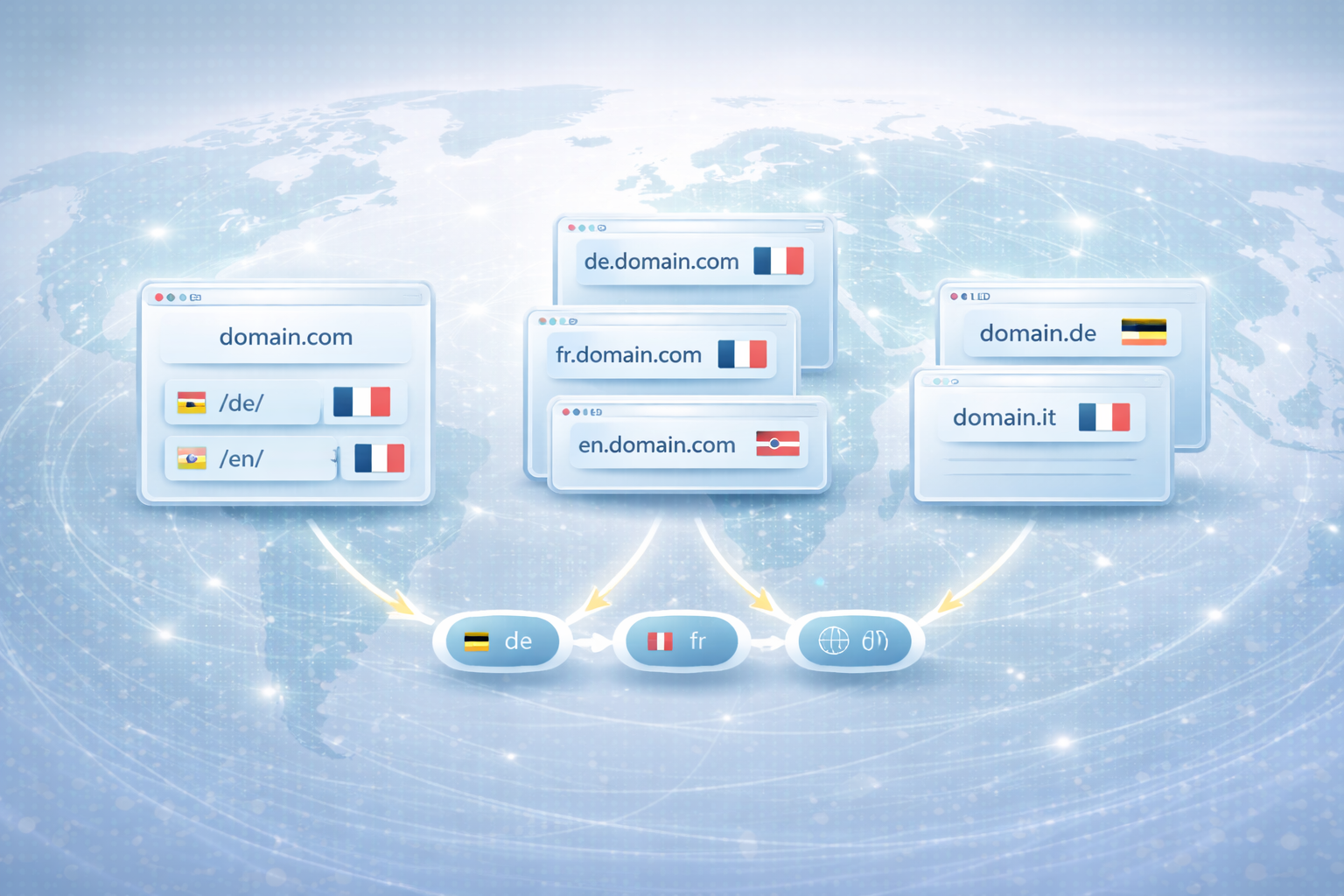
The central structural question: subfolder, subdomain or ccTLD?

Before content is translated, the domain strategy must be defined.

There are three common models:
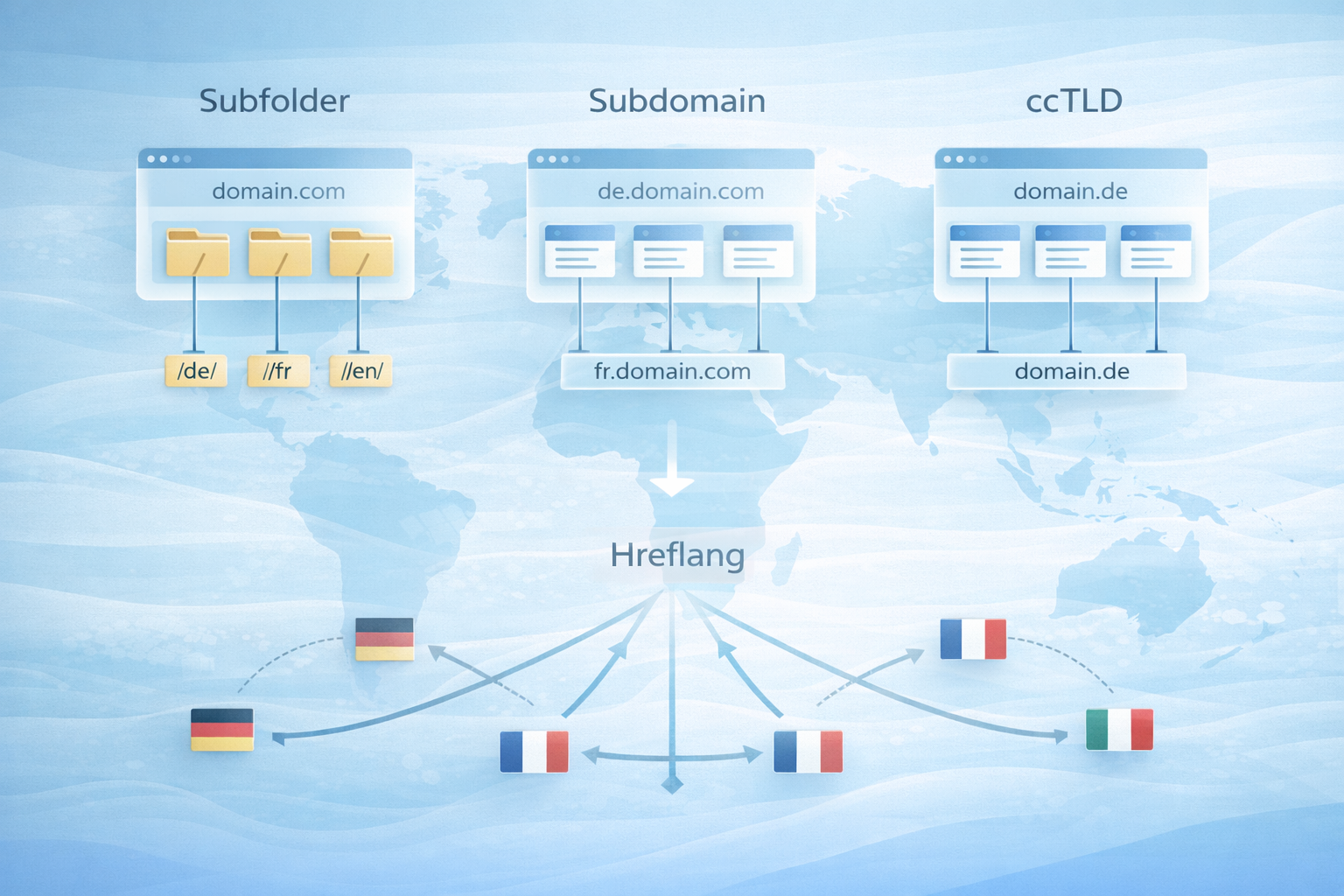
1st subfolder

example.de/en/
example.de/fr/

advantage:
All markets benefit from strong domain authority.

Google recognizes a clear language structure.

Technically and SEO-wise, it is usually the most efficient solution.

2nd subdomain

en.example.com
fr.example.com

advantage:
Clear segregation of markets.

Disadvantage:
SEO signals are bundled more weakly.

More effort when building authority.

3rd ccTLD

example.de
example.fr
example.it

advantage:
Strong local signal

Disadvantage:
Each domain must establish authority separately.

High expenditure on content, backlinks and maintenance.

Shopify Markets and international structure

With “Shopify Markets,” Shopify offers an integrated solution for international expansion.

But Markets is no substitute for an SEO strategy.

The decisive factor is:

  • How is the URL structure set up?
  • Are subfolders used?
  • How is Hreflang integrated?
  • How is duplicate content avoided?
  • What market prioritization exists?

Technical simplicity does not automatically mean SEO excellence.

Hreflang — the most misimplemented element

Hreflang tells Google:

Which language or country version is intended for which user.

example:

1<link rel="alternate" hreflang="de" href="https://example.com/de/produkt" />
2<link rel="alternate" hreflang="en" href="https://example.com/en/product" />
3<link rel="alternate" hreflang="fr" href="https://example.com/fr/produit" />
4<link rel="alternate" hreflang="x-default" href="https://example.com/" />

What is important is:

  • Each version must reference all others
  • Self-reference should not be missing
  • Language and country must be combined correctly (e.g. de-DE, en-US)

Faulty hreflang setups result in:

  • wrong rankings
  • Wrong country assignment
  • cannibalization
  • Traffic loss

Duplicate content as an international risk

Without a clear structure, the following are often created:

  • identical content on multiple domains
  • Wrongly set canonicals
  • conflicting voice signals

Google is reacting to this by losing ranking.

International SEO needs:

  • clear URL structure
  • unique voice logic
  • clean indexing control
  • structured sitemap per market

Content strategy instead of 1:1 translation

Many companies translate content directly.

But successful international SEO means:

  • local keyword research
  • cultural adjustment
  • Take into account other search intent
  • Country-specific competition analysis

example:

“Buy protein powder”
is not automatically the same as the search behavior in France or Italy.

International SEO is strategic market development.

Ranking Strategy: Prioritize Markets

Not all markets at the same time.

A meaningful expansion follows:

  1. Analyze existing traffic
  2. Market size
  3. contest
  4. Logistical ability
  5. Legal requirements

International SEO is an investment model — not an experiment.

🚀 Develop an international Shopify SEO strategy

Do you want to expand internationally without ranking risk?

We develop a scalable domain strategy, implement a clean hreflang setup and define a clear ranking roadmap for your target markets.

👉 Plan internationalization now.

Shopify SEO 2026: What really ranks — and what you can save yourself
Shopify migration without loss of ranking: How to keep your SEO traffic stable
Shopify SEO Guide: How to optimize your store with JSON-LD, Structured Data & Liquid Templates
Shopify & GEO: How to optimize your online shop for AI search engines and generative systems
Shopify SEO with E-E-A-T: How to rank on Google in the long term with Experience, Expertise, Authoritativeness & Trust
Why Shopify Checkout converts so well — and what other systems don't
Shopify UX optimization: product pages, checkout, and A/B testing for higher conversion rates
Shopify Metafields: Implement dynamic product data with Liquid & JSON
UNHYDE•UNHYDE•UNHYDE•UNHYDE•UNHYDE•UNHYDE•