Hardly any company plans to change their shop system out of enthusiasm.
The desire to replatform usually comes from a feeling:
But not every problem is a platform problem.
A shop system change is one of the most profound interventions in a company's digital infrastructure. It not only concerns technology, but also:
That is why the decisive question is not whether Another system sounds better — but whether it is strategically necessary.
Replatforming makes sense when structural limits are reached.
examples:
When performance suffers permanently even though optimizations have been made.
When scaling (international, traffic, product range) is barely technically possible.
When maintenance costs and technical debts slow down growth.
When checkout, UX, or integrations are limited due to the system.
In such cases, the system change is not a risk — but an investment in sustainability.
The shop system is often blamed even though the real problem lies elsewhere:
A new system doesn't solve strategic problems.
If you want to compensate for a structural problem with technology, you just postpone it.
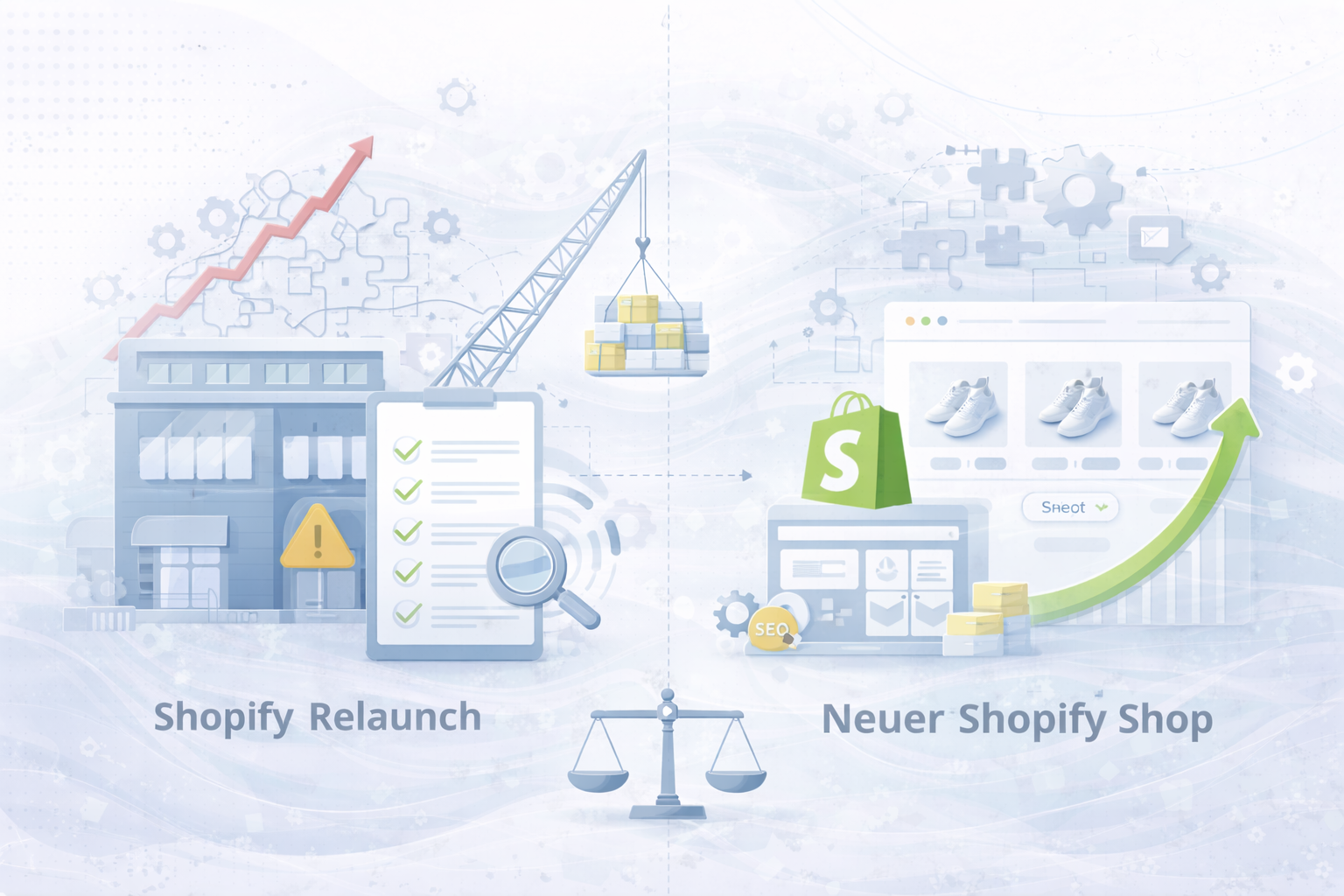
A change in shop system often looks like a relaunch to the outside world.
Internally, however, it is a profound restructuring.
Risks include:
Professionally planned replatforming minimizes these risks — but it doesn't completely eliminate them.
This is where things get strategically interesting.
Companies change frequently:
The motivation behind the change determines the choice of system.
Anyone who prioritizes growth and conversion often finds the most stable basis in Shopify.
If you need a high level of customization, you are more likely to stick with more complex systems.
Don't:
“Which system is better? ”
But:
“What requirements will we have in 3-5 years? ”
A shop system should not only reflect the current state of affairs — but also support the future business model.
A change in shop system can bring enormous benefits — if it results from clarity.
It is useful when:
It is not useful if:
Replatforming is not a reset.
It is a strategic restart — if properly planned.
Changing a shop system is not a design decision — but a course for years to come.
If you are unsure whether replatforming makes sense for your business or only masks symptoms, we will analyse your current structure and show you a realistic perspective.
👉 Strategically review replatforming with UNHYDE

Get in touch
contact now