Many companies believe that successful online shops are characterized by modern design, animations or trendy layouts.
But if you look closer, you can see:
The most successful shops often appear surprisingly quiet.
They're not spectacular.
They're structured.
And this is where the difference between a shop that exists — and a shop that sells — starts.
Architecture in e-commerce does not describe the visual appearance.
It describes:
A shop without a clean architecture can function in the short term.
It will be expensive in the long term.

The question is not:
“How many categories do we have? ”
But:
“Does a new user understand where they need to click within seconds? ”
Many shops do not lose conversion in the checkout, but already in navigation.
Too many variants, too many cross-sells, too many filters —
Decision-making stress is one of the biggest conversion killers.
Here, architecture means:
Reduction, prioritization, logical paths.
Performance, load times, scalability.
A shop that becomes unstable during traffic spikes not only loses sales — it also loses trust.
This is also where the choice of system is decided:
Shopify, Shopware, WooCommerce — they're architectural decisions.
A checkout is not a form.
It is the most sensitive phase of the entire shop.
Each additional hurdle has an exponential effect.
internationalization.
More products.
More traffic.
More markets.
Architecture determines whether growth is possible — or will be expensive.
Many companies are trying to solve structural problems visually.
More animation.
More graphics.
More highlights.
But good design reinforces good structure.
It doesn't replace them.
Conversion optimization without structural analysis is cosmetic.
When:
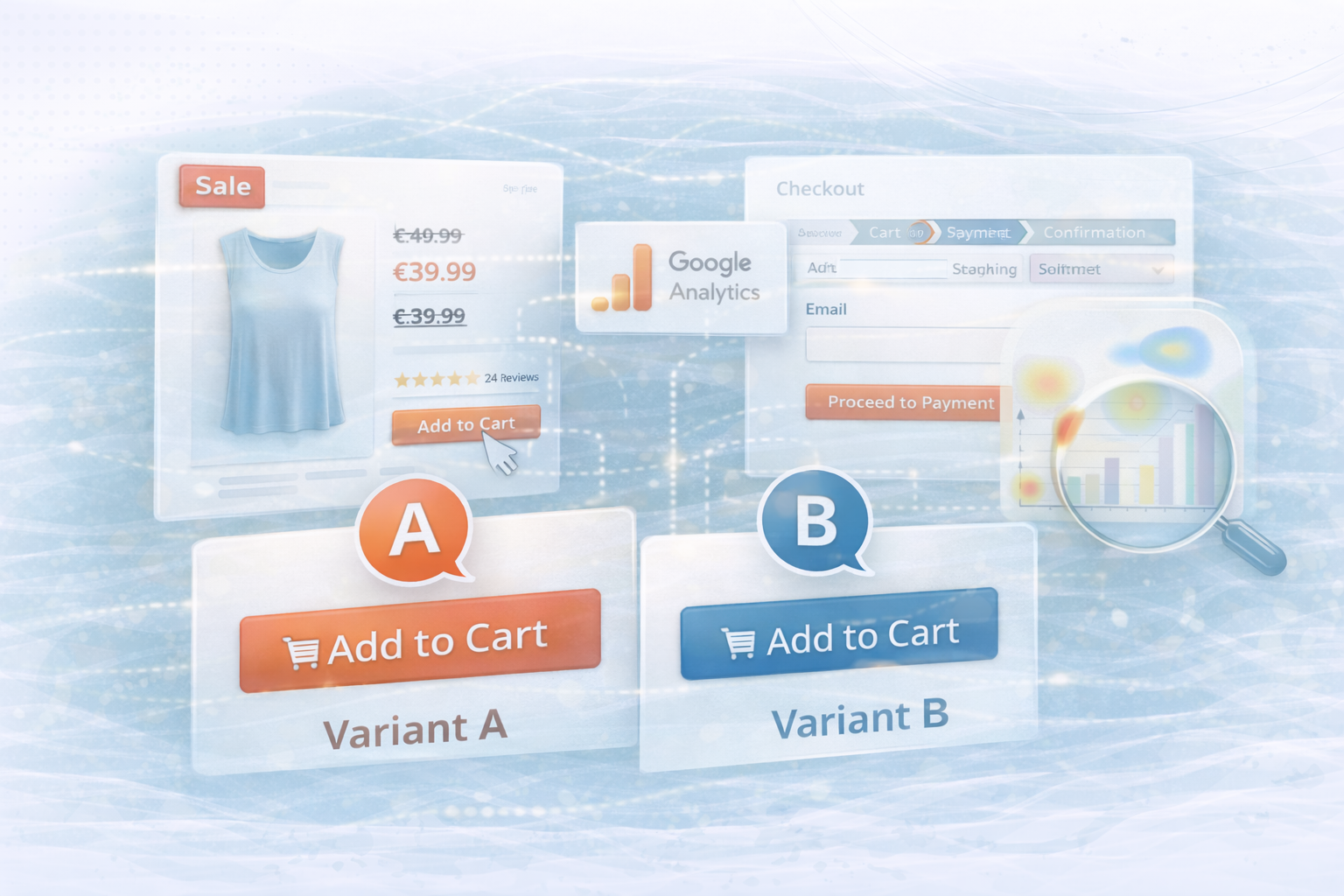
No button test will solve the problems.
Shopify, WooCommerce or Shopware are not just tools.
They pretend:
Whoever selects a system chooses an architectural philosophy.
Many shops invest permanently in:
But structural clarity has a more lasting effect than any campaign.
Architecture isn't sexy.
But it is scalable.
The best shops in the world aren't loud.
They are logical.
Reduced
Predictable.
Safe
E-commerce architecture is not a detail.
It is the foundation.
E-commerce rarely fails because of design — but because of architecture.
If you want to know how sustainable the structure of your shop really is and where there is untapped potential, we analyse your setup holistically — from information architecture to checkout.

Get in touch
contact now