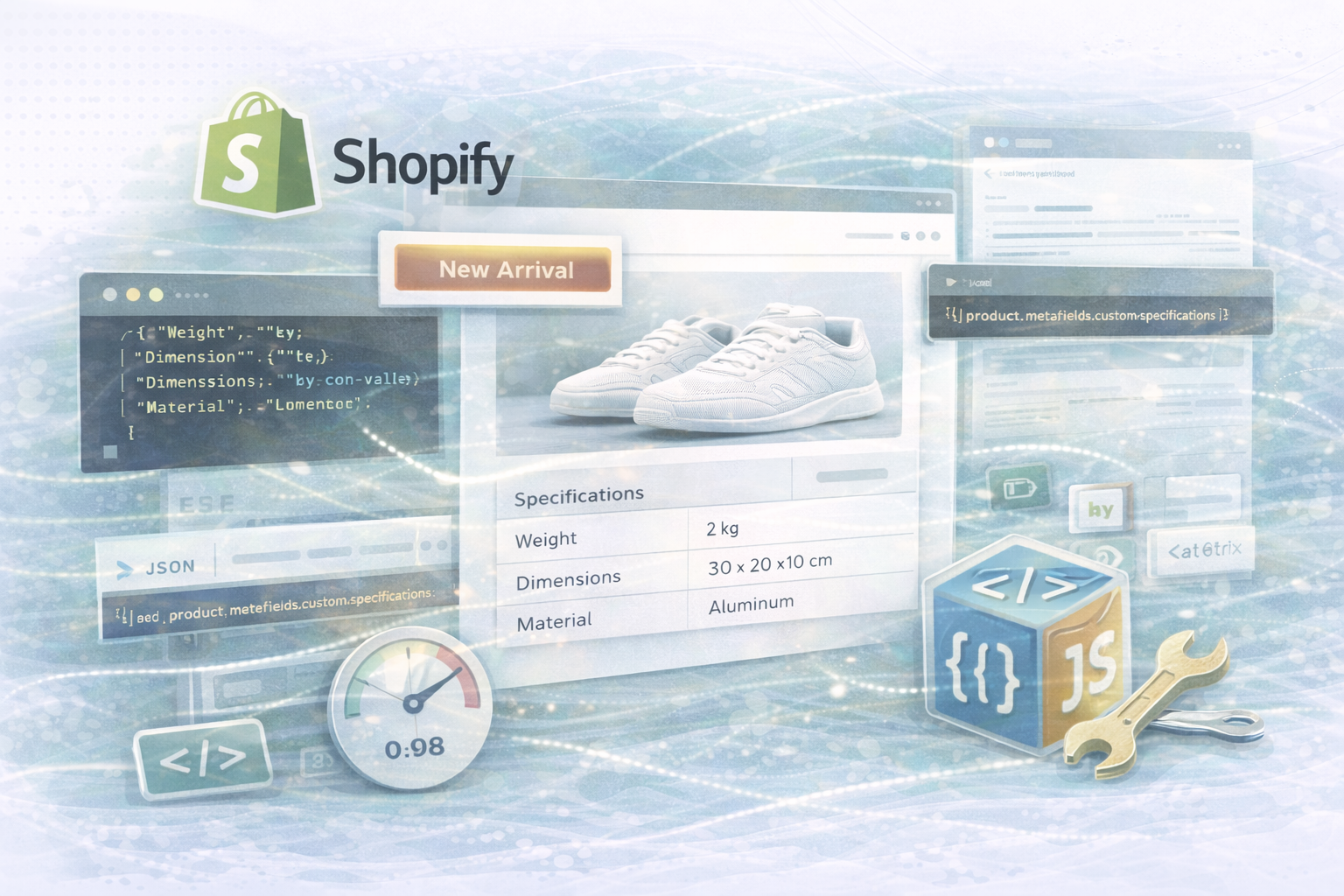
Classic search engine optimization is currently fundamentally changing. While SEO has long aimed to appear as high as possible in a list of search results, the focus is increasingly shifting to Answer machines: ChatGPT, Perplexity, Gemini, or AI Overviews.
Here comes Generative Engine Optimization (GEO) into the game. GEO describes strategies that structure content in such a way that large language models can understand, quote, and integrate it into answers.
Especially in e-commerce — and especially in the Shopify ecosystem — GEO offers enormous opportunities. Many shops have structured product data, clear templates and automatable content. If this data is processed correctly, it can be used efficiently not only by search engines but also by generative AI systems.
This article shows in a practical way how to structure your Shopify store technically and in terms of content so that it is suitable for Geo optimized is.
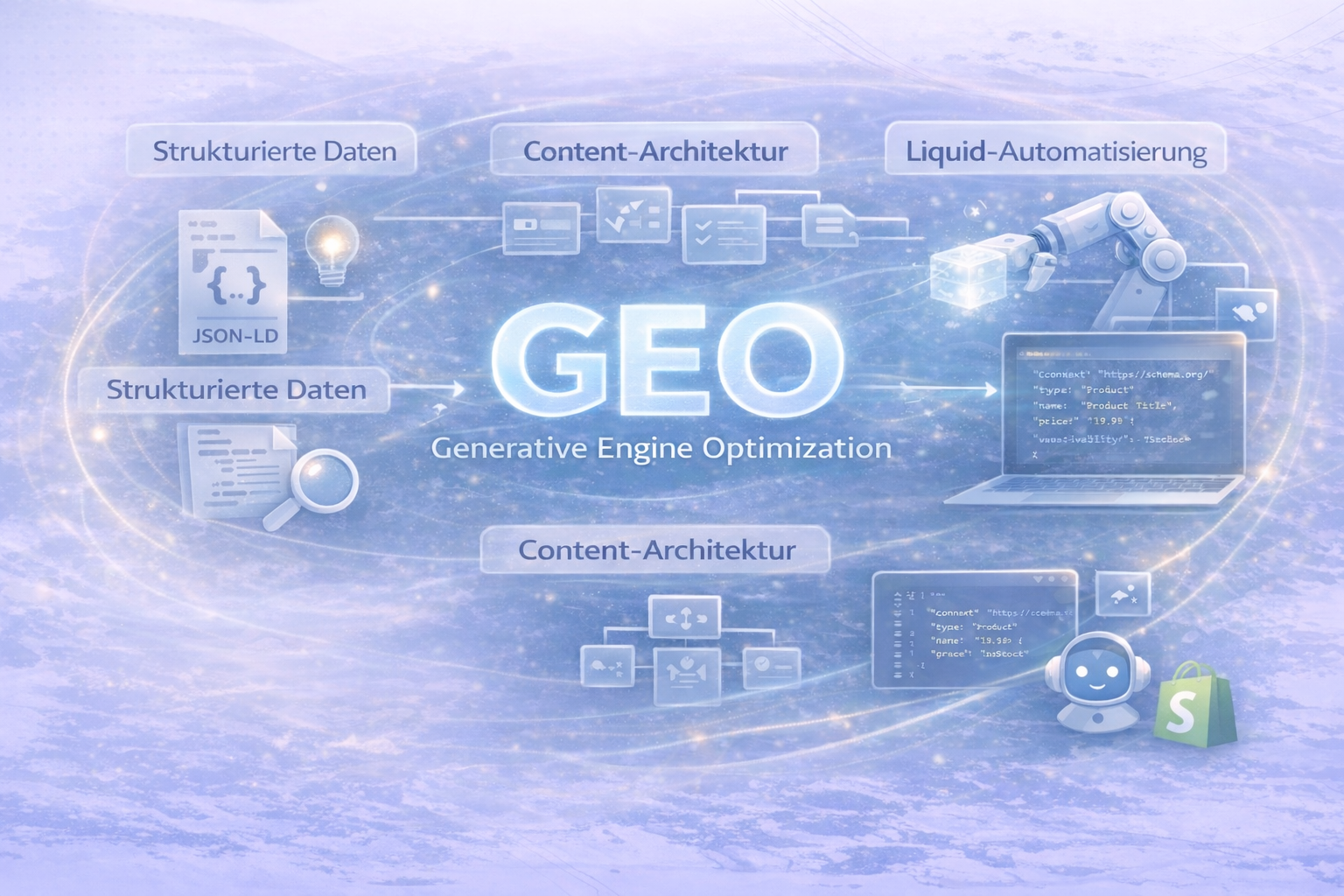
Shopify has an architecture that is ideal for structured data and machine-readable content.
For one thing, Shopify works with Liquid Templatesthat generate content dynamically. On the other hand, product data, variants, metafields and collections are already available in clearly defined data structures.
That means:
Much of the information that generative systems require already exists in the backend of a Shopify store.
The challenge is to process this information in such a way that it:
This is exactly where GEO strategies come into play.
Large language models often rely on information that is already available in a structured manner. This includes:
Structured data helps search engines and AI systems to clearly interpret important information such as price, availability, or reviews.
Without this structure, models must extract content from running text — which is significantly less reliable.
Structured data enables:
For example, typical Shopify schemes include:
This information is usually provided by JSON-LD scripts integrated.
A common mistake in Shopify themes is incomplete schema markup. Many themes only deliver minimal data.
With your own snippet, you can provide significantly more context.
Create a new file in the theme editor:
snippets/product-schema.liquidThis is where you define your JSON-LD schema.
<script type="application/ld+json">
{
 "@context": "https://schema.org/",
 "@type": "Product",
 "name": "{{ product.title }}",
 "image": [
   "{{ product.featured_image | img_url: '1024x1024' }}"
 ],
 "description": "{{ product.description | strip_html | escape }}",
 "sku": "{{ product.selected_or_first_available_variant.sku }}",
 "brand": {
   "@type": "Brand",
   "name": "{{ product.vendor }}"
 },
 "offers": {
   "@type": "Offer",
   "url": "{{ shop.url }}{{ product.url }}",
   "priceCurrency": "{{ shop.currency }}",
   "price": "{{ product.selected_or_first_available_variant.price | money_without_currency }}",
   "availability": "https://schema.org/{% if product.available %}InStock{% else %}OutOfStock{% endif %}"
 }
}
</script>
Here you use Liquid variablesto dynamically integrate product information from Shopify.
Then open your product file, usually:
sections/main-product.liquidand paste the snippet:
{% render 'product-schema' %}This automatically creates the scheme for all products generated in the shop.
Many Shopify stores treat product pages purely transactionally. However, this is not optimal for GEO.
Generative systems prefer content that:
For example, a good product page includes:
“Our protein powder is of high quality. ”
“This protein powder contains 24 g of whey protein per serving and is particularly suitable for building muscle after intensive training sessions. ”
Models more easily provide such information in answers.
Metafields are one of the most underrated tools in Shopify.
This data can then automatically appear in the content.
Assume you define a metafield:
product.metafields.custom.use_caseYou can then display it in the template:
{% if product.metafields.custom.use_case %}
<div class="product-use-case">
<h3>Typische Anwendung</h3>
<p>{{ product.metafields.custom.use_case }}</p>
</div>
{% endif %}
This automatically creates more context-rich contentwithout having to manually maintain every page.
FAQ sections work great for AI search because they provide clear question-answer structures.
In addition, you can store schema markup for this purpose.
<script type="application/ld+json">
{
 "@context": "https://schema.org",
 "@type": "FAQPage",
 "mainEntity": [{
   "@type": "Question",
   "name": "Ist das Produkt vegan?",
   "acceptedAnswer": {
     "@type": "Answer",
     "text": "Ja, dieses Produkt enthält ausschließlich pflanzliche Inhaltsstoffe."
   }
 }]
}
</script>
This structure makes content easier to interpret for search engines and AI models.
Many Shopify stores underestimate the role of their blog.
LLMs prefer content that Accurately and factually formulated because they can generate answers more easily from them.
Generative systems not only analyze individual pages, but also their context across the web.
Clear internal links help to build topic clusters.
example:
/blog/shopify-geo-guide
/blog/shopify-structured-data
/blog/shopify-product-seo
All articles link to each other.
This is how a Topic clusters related to Shopify SEO and GEO.
A common misconception is that GEO is replacing classic SEO.
In reality, both disciplines build on each other.
Many AI systems continue to rely on search engine indexes.
GEO simply extends these strategies by an additional level: Optimization for generative responses.
Generative engine optimization is changing the requirements for content on the web — particularly in e-commerce.
Anyone who uses these options can structure their shop in such a way that it is optimally readable not only for Google, but also for generative AI systems.
The future of search is no longer just to be found.
It consists of The answer to be.
With UNHYDE Let's build Shopify stores that not only look good but also technically scale. Our focus is on cleaner architecture, performance, and future-proof SEO — including generative engine optimization.
We help brands set up their Shopify stores technically and structurally in such a way that product data, content and templates are optimal for Search engines and generative systems are processed.
From structured data architecture, liquid automation and GEO content strategies We develop solutions that not only work in theory — but also in a real e-commerce setup.

Get in touch
contact now