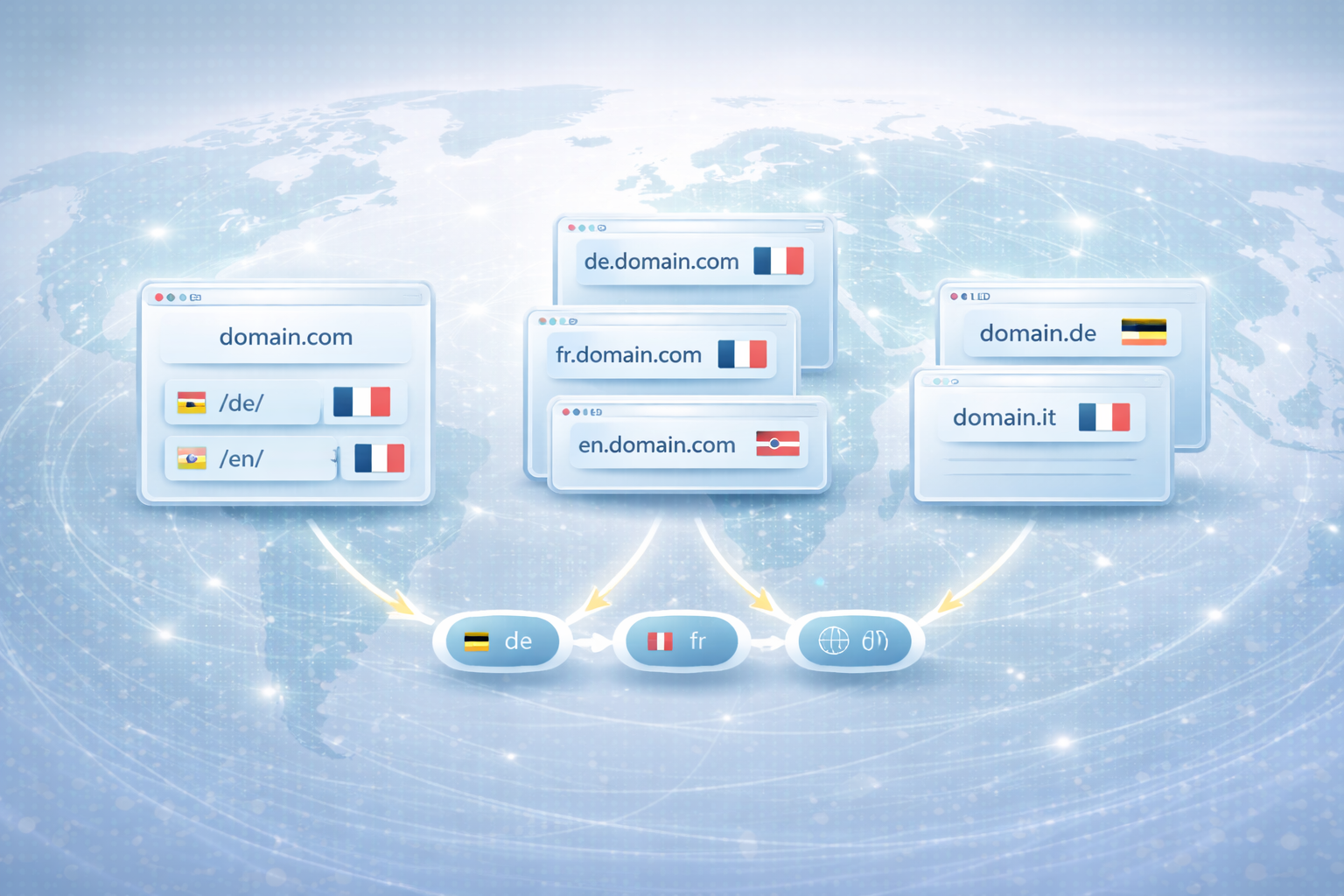
When it comes to internationalization, many companies are faced with the question:
Should we set up multiple Shopify stores?
Or solve everything about Shopify Markets in one store?
The decision has a technical effect —
But it's strategic.
An incorrect structure is difficult to correct later on.
Shopify Markets makes it possible to manage multiple countries and currencies within a single Shopify store.
advantage:
Centralized management and reduced technical complexity.
exist.
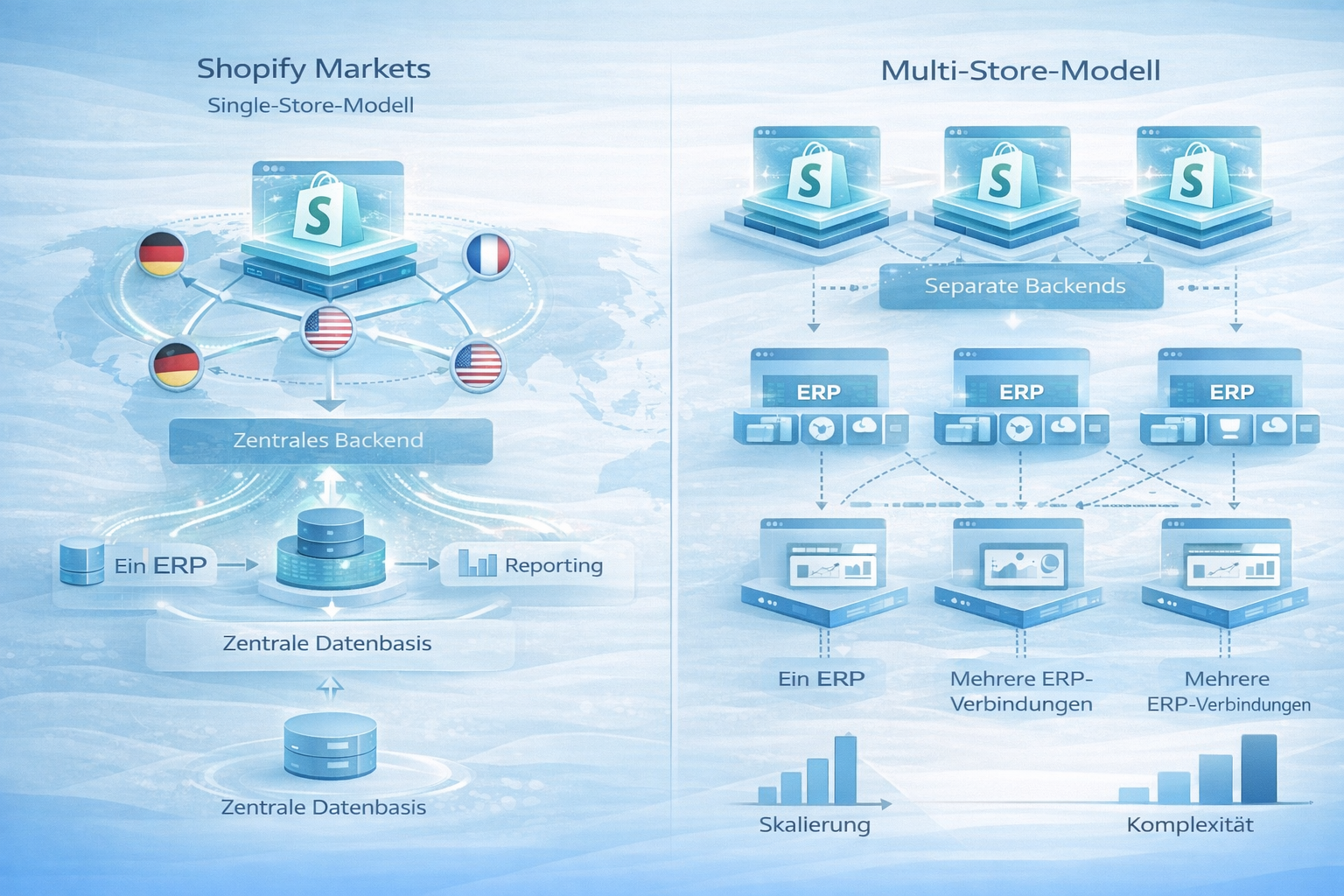
A multi-store model means that multiple standalone Shopify stores run in parallel. Each of these stores is technically a separate Shopify instance with its own infrastructure.
Typical examples include different stores for different countries:
Each of these stores functions completely independently of the others. This means that every shop has its own configuration and systems.
The big advantage of such a setup is maximum flexibility. Each market can be managed independently, which can be particularly relevant when it comes to very different business models or marketing strategies.
The disadvantage, however, lies in significantly higher operating costs. Multiple stores also mean multiple systems that must be maintained, synchronized and further developed.
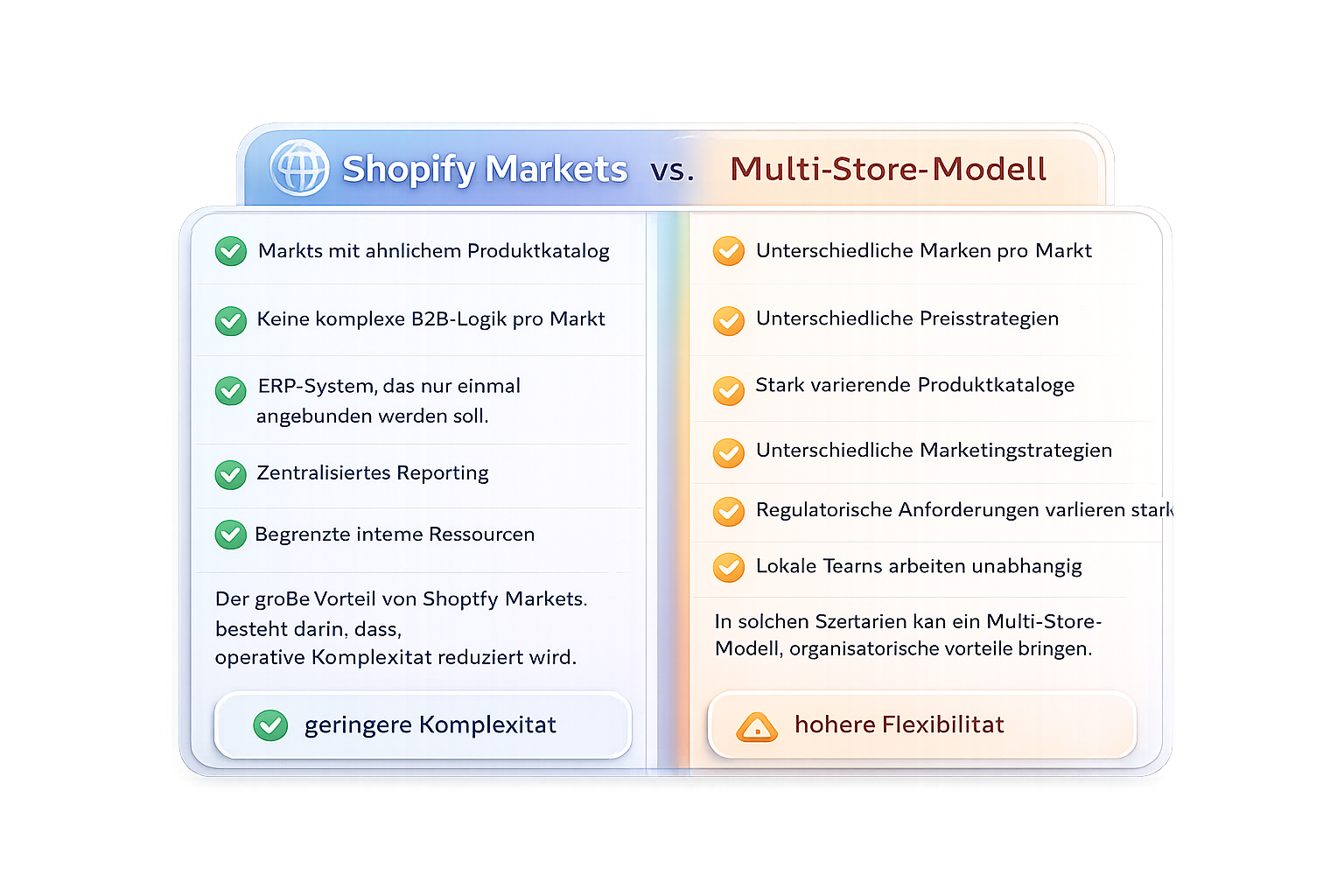
Shopify Markets takes a different approach. Instead of running multiple stores, a central Shopify store is used, which manages different markets within a common infrastructure.
This model is particularly suitable for companies whose international markets function relatively similarly in terms of structure.
The big advantage of Shopify Markets is that it reduces operational complexity. Prices, currencies, languages and shipping rules can be defined for different countries without having to operate multiple stores.
For many medium-sized companies in particular, this model is often the most efficient solution, as it enables growth without unnecessarily fragmenting the system landscape.
A multi-store setup is particularly relevant when markets or business models differ significantly from one another.
In such cases, it may be useful to run different Shopify instances to maintain maximum control over each region.
In such scenarios, a multi-store model can provide organizational benefits, as teams can act independently on a regional basis.
However, more freedom also means more complexity.
A common mistake is that companies set up several stores very early on, even though the organizational structure does not even require this.
This early fragmentation often leads to operational problems.
Instead of making scaling easier, this often results in additional effort that can even slow down growth.
The architecture of an international shop also has major effects from an SEO perspective.
Here, a central Shopify store with Shopify Markets can often offer advantages, as all content is built within the same domain structure.
However, it is crucial that SEO should never be viewed in isolation. The shop architecture must always be evaluated in the context of organization, technology and business strategy.
Another important aspect is technical integration with other systems, in particular with ERP and BI systems.
From an integration perspective, a central store is often easier to operate.
In a multi-store model, on the other hand, the integration logic multiplies. Each additional store must be connected, monitored and maintained.
In the long term, this leads to higher maintenance costs and more complex data structures.
The decision between Shopify Markets and a multi-store model should therefore never be made solely on the basis of technical options.
Rather, the decisive question is:
What will our organizational structure look like in three to five years?
Companies with centrally managed teams and global processes often benefit from a market model.
Companies with highly localized teams and regional business models, on the other hand, can benefit from a multi-store setup.
The right architecture is therefore less a technical decision — but a strategic one.
Do you want to avoid a wrong structure becoming expensive later on?
We analyze your markets, organization, ERP structure and growth goals — and develop a reliable architecture decision.

Get in touch
contact now